
In This Issue
Training and Operations: Nationwide Training and Arrests
OSINT Stories That Matter: William Largent
OSINT Tradecraft: Trafficking Indicators Guide
Who We Are
The Skull Games Task Force employs Open Source Intelligence to IDENTIFY sexual predators and their victims, enabling law enforcement to INTERDICT the cycle of abuse. Our mission is to liberate survivors and EMPOWER them with the opportunity for a life of hope, healing, and freedom. The Task Force provides direct support to law enforcement through small teams or as a massive expedition, bringing together the collective capability of more than 400 elite volunteers. This counter-sexual exploitation offensive leverages considerable expertise and resources to fight human trafficking and sexual exploitation. With us as the HUNTERS, we get into the heads of predators, in our own “SKULL GAME”…
March Operations
by Olinda Cardenas
- Predators and Victims Identified: 21
- Predators Arrested: 21
- Individuals Trained in Countertrafficking: 302
In March, Skull Games Solutions continued to deliver intelligence-driven support across multiple states, pairing advanced training with real-world operational impact. From coordinated operations in Alabama and Oklahoma to national speaking engagements and community outreach, the month reflected the power of collaboration, preparation, and persistence.
Operational Impact:
The results were nothing short of significant:
- 7 buyers arrested in Alabama
- 2 buyer arrests in Oklahoma
- 3 human trafficking victims recovered
- 3 traffickers identified or arrested
- 2 additional rapists identified and cleared from a prior Phoenix case
In southern Alabama, Skull Games supported a coordinated operation following Advanced Human Trafficking Operations training delivered to eight local law enforcement agencies. Hosted by the Spanish Fort Police Department and coordinated alongside The Little Tree Project, the operation demonstrated the direct impact of training translated into action.
During the operation, one potential trafficking victim was identified along with her trafficker, and on-scene victim support was provided by The Little Tree Project, an Alabama-based advocacy organization doing critical work in the field. Additional victims and traffickers were also identified, with investigations continuing beyond the operation.
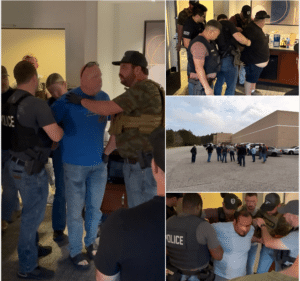
In Oklahoma, remote intelligence support contributed to buyer arrests in Antlers and Valliant, reinforcing how coordinated efforts can extend operational reach even without a physical presence.
Phoenix operations at the end of the month delivered one of the most profound outcomes. Among the victims recovered was a survivor connected to a prior gang rape case. While on scene, detectives were able to respond and obtain a positive identification of two of her attackers. As a direct result, two sexual assault cases, both over four years old, were cleared through DNA confirmation and victim identification. This outcome underscores how present-day operations can bring long-awaited justice to past crimes.
SGS Speaking & Community Engagement:
March also emphasized the importance of knowledge sharing and community empowerment.
On March 16, Skull Games Solutions own Liz Bradt and Janie Salazar spoke at the SANS OSINT Summit, presenting on targeting methodology in OSINT investigations and how structured approaches can improve investigative outcomes.

Just two days later, on March 18, Joe Scaramucci and Liz Bradt presented at the North Carolina Human Trafficking Symposium, sharing practical OSINT tips and techniques tailored specifically for human trafficking investigations.
At the community level, Skull Games supported empowerment initiatives in Sapulpa, Oklahoma, on March 27th and 28th. These events, led by Jeff Tiegs and Lauren Norris, included community-focused training and a women’s self-defense course, equipping individuals with knowledge and tools to better protect themselves and others.
OSINT Stories That Matter: William Largent
by Tom Phelan
In this new section, we ask the Skull Games community for impactful stories from their work. We encourage our Hunters to share short reflections on the following:
- A moment where our work directly supported an investigation or operation.
- An insight or lesson learned that changed how they approach OSINT or analysis.
- A time when collaboration within the Task Force or with partners made a difference.
- An “aha” moment where assumptions were challenged, or clarity was gained.
- What motivates you to continue volunteering and contributing to the mission?
We want to take time to reflect on stories that focus on the work, the process, and the impact, highlighting professionalism, teamwork, and growth. The month’s story comes from William Largent.
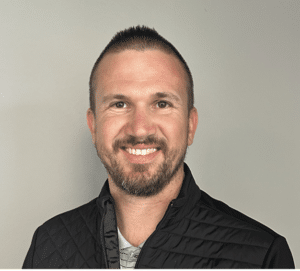
I remember the exact moment when it clicked for me. During my first three or four expeditions, I was frustrated. I couldn’t seem to find meaningful information on victims or persons of interest, and I felt like I wasn’t contributing—that I was letting the team down. Then someone shared something that changed everything. I don’t even remember who said it, but they said: If all you do during the entire weekend is provide one link that helps law enforcement close a case or find a victim, then it was worth it. That shifted my entire mindset. I stopped feeling the pressure to be the one who uncovered the stable, the big operation, or the victim on my own. I realized I was part of a team—and my contribution mattered, even if it felt small.
That realization reinforced another belief about why this work is so important. During expeditions where survivors shared their stories, I kept hearing the same message over and over: If only someone had done this for me. I can’t shake that. What if you were the one? Or your child? Your mother? Your best friend? If you knew that an army of some of the biggest-hearted people were moving heaven and earth to find and rescue you—would that matter? I know if it were my loved one, it absolutely would.
OSINT Tradecraft: Trafficking Indicators Guide
by Tom Phelan
In the intelligence world, information requirements guide our research. The next step in the process is to develop a list of indicators to look for when conducting research to answer the question of the intelligence requirement. In our case, those requirements focus on countering human trafficking. Therefore, if the question is who is being exploited? We need to identify indications that someone is a victim. This guide provides some publicly available intelligence sources to recognize patterns, identify potential indicators in online spaces (escort ads, social media, forums), map networks, and generate actionable leads for reporting or further investigation. Below are example sources for OSINT practitioners focused on trafficking.
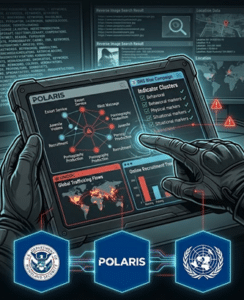
- Polaris Project
Source: Polaris Project – Recognizing Human Trafficking and Sex Trafficking page. Polaris operates the U.S. National Human Trafficking Hotline data, giving it one of the largest real-world U.S. case datasets.
Pros: Grounded in thousands of hotline reports; strong emphasis on U.S. sex trafficking business models (25+ typologies from their reports); highlights relational dynamics like intimate partner or family recruitment common in domestic cases; cautions against visual stereotypes and stresses “know the story, not just the signs.” Excellent for contextualizing online ads or profiles. Free resources and training modules available.
Cons: U.S.-focused, so less coverage of international flows; some materials push back on over-reliance on visible “signs” (useful philosophically but requires more narrative digging in pure OSINT); hotline data reflects reported cases, which may undercount certain hidden networks.
What Polaris Highlights as Indicators:
- Anyone under 18 in commercial sex is a trafficking victim by law.
- Wants to stop selling sex but feels scared/unable to leave.
- Reluctant engagement due to pressure from a third party.
- Lives where they work or is transported under guard.
- Presence of a pimp/manager (often called “boyfriend” or handler).
- Works in high-risk venues/models: escort services, illicit massage, strip clubs, pornography production, street solicitation.
- Children living with/supporting family members with substance abuse or abuse histories.
- Inability to provide consistent details about their situation; controlled documents/money/movement.
- Online: Multiple or inconsistent profiles, explicit content with signs of control, unexplained lifestyle/income.
OSINT Takeaway: Use this to evaluate escort ads, social media “modeling” posts, or OnlyFans-style accounts. Cross-reference usernames, phone numbers, or images across platforms for inconsistencies (age discrepancies, controlling comments, repeated locations). Polaris data helps you understand common U.S. models, so you can target searches toward specific business patterns rather than generic keywords.
- DHS Blue Campaign
Source: DHS Blue Campaign – Identify a Victim and associated indicator cards/toolkits.
Pros: Straightforward, checklist-style indicators designed for quick recognition by the public, hotels, transportation, and first responders. Strong integration of behavioral, physical, and situational cues that translate well to OSINT (e.g., social isolation visible online, sudden behavioral shifts on profiles). Includes tech-specific nods like social media use. Wallet-sized cards and training materials make it easy to operationalize. Ties directly into U.S. law enforcement reporting (HSI tips).
Cons: More general human trafficking (includes labor), though sex trafficking indicators are prominent; less depth on nuanced relational grooming or specific business typologies compared to Polaris; designed for broad awareness rather than deep investigative analysis.
What DHS Lists as Key Indicators:
- Physical: Signs of abuse/sexual trauma, restraint, torture; deprivation of food/sleep/medical care; lack of possessions.
- Behavioral/Social: Fearful, anxious, submissive, paranoid demeanor; sudden dramatic behavior changes; defers to another person to speak/answer; disconnected from family/friends/community; child stopped attending school.
- Situational: Juvenile engaged in commercial sex acts; works excessively long/unusual hours; lives where they work or transported between sites; no control over ID, money, or schedule; appears malnourished/exhausted/disoriented.
- Additional context: In hotels, online ads, or venues—watch for controlling companions, restricted movement, or inconsistent stories.
OSINT Takeaway: Apply these when scraping or monitoring online ads/profiles. Look for photo inconsistencies (bruises, malnourishment via reverse image search), location patterns (same hotels/motels repeatedly), or profile histories showing isolation/sudden explicit shifts. Correlate with Polaris models for stronger signals.
Report findings to the National Hotline (1-888-373-7888 or BeFree to 233733) or HSI.
- UNODC Global Report on Trafficking in Persons
Source: UNODC Global Report on Trafficking in Persons 2024.
Pros: Broadest statistical view from 150+ countries’ detected cases; reveals macro trends like rising online recruitment (“hunting” targeted profiles vs. “fishing” via ads), post-pandemic resurgence in sexual exploitation detections (especially girls), and digital platform use. Helps OSINT practitioners anticipate shifts in tactics, geographies, or victim demographics. Excellent for hypothesis generation (e.g., which platforms or keywords to monitor next).
Cons: Relies on government-reported detections, which skew toward more visible cases; less granular behavioral checklists for day-to-day OSINT; global scope dilutes U.S.-specific tradecraft; statistical rather than operational—fewer “spot this in an ad” cues.
What the UN Report Emphasizes on Sex Trafficking/Detection:
- Women and girls comprise ~61% of detected victims overall; majority of girl victims (60%) trafficked for sexual exploitation.
- Sexual exploitation remains a major form (though forced labor detections have risen to 42% globally in recent data).
- Common methods: Deception via false promises (jobs, relationships, education); control through debt, violence, threats, isolation.
- Digital amplification: “Hunting” (proactive targeting of vulnerable profiles on social media/dating/gaming apps) and “fishing” (passive ads waiting for responses); use of fake profiles and duplicated legitimate platforms.
- Venues/settings: Hotels, massage parlors, night clubs, apartments, street prostitution, and increasingly internet-based exploitation.
- Challenges: Under-detection of certain cases; regional variations; girls and children increasingly visible in detections.
OSINT Takeaway: Leverage trends to prioritize monitoring—focus searches on social media hunting patterns, dating apps, or gaming platforms. Use the report to understand why certain keywords or victim profiles spike in detections. Combine with Polaris/DHS for ground-level validation: global digital tactics + local indicators = better targeting of ads or networks. Useful for long-term campaign planning rather than immediate leads.
Overall Takeaway for OSINT Practitioners
Polaris gives you rich U.S. case-informed context and business model nuance for evaluating online sex trade content. DHS Blue Campaign supplies clean, cross-referenceable checklists that map directly to digital footprints (inconsistent profiles, control signals, juvenile red flags). UN Global Report provides the strategic overlay—trends in digital recruitment and global flows—to guide where and how you hunt for patterns without wasting cycles on low-yield areas.
Sample Practical Workflow:
- Monitor platforms using targeted searches informed by UN trends (hunting/fishing language, common venues).
- Evaluate hits against DHS physical/behavioral/situational clusters.
- Deep-dive context and typologies with Polaris data.
- Verify via multi-source OSINT (reverse images, username searches, location cross-checks, metadata).
- Document and report to authorities: National Human Trafficking Hotline or local task forces. Never endanger yourself or potential victims.
Trafficking networks adapt quickly—digital tools lower recruitment barriers but also leave more breadcrumbs for disciplined OSINT. Build your personal indicator matrix from these sources, test it against open data, and refine. Awareness plus rigorous pattern recognition disrupts predators. Stay precise, legal, and victim-centered. The goal is intelligence that leads to disruption and rescue.
Upcoming Events
- Task Force Expedition XIX | May 16 – 17 | Ybor City, FL
- Task Force Expedition XX | August 8 – 9 | Gainesville, VA
- Task Force Expedition XXI | November 7 – 8 | Austin, TX
Skull Games Links
- Social Media: Follow Us Linkedin Facebook Insta Twitter
- Donations: Support Us
- Law Enforcement: Partner With Us
- Volunteer: Join Us
About the Author
Tom Phelan is an active-duty U.S. Army Intelligence Officer with over five years of experience in OSINT and a dedicated volunteer for Skull Games Task Force.

Olinda Cardenas is a former crime scene investigator turned cybercrime enthusiast. She specializes in OSINT and financial crime investigations and is a dedicated volunteer with Skull Games