

In This Issue
Operations: Successful Operations in Llano, TX (Operation Red Light), Nashville, TN, and Gulfport, MS.
Spotlight: Section 1591: Sex Trafficking of Children in the USA Documentary
Tradecraft: Deploying Agentic AI for OSINT Investigations
Who We Are
The Skull Games Task Force employs Open Source Intelligence to IDENTIFY sexual predators and their victims, enabling law enforcement to INTERDICT the cycle of abuse. Our mission is to liberate survivors and EMPOWER them with the opportunity for a life of hope, healing, and freedom. The Task Force provides direct support to law enforcement through small teams or as a massive expedition, bringing together the collective capability of more than 400 elite volunteers. This counter-sexual exploitation offensive leverages considerable expertise and resources to fight human trafficking and sexual exploitation. With us as the HUNTERS, we get into the heads of predators, in our own “SKULL GAME”…
June Operations
by Olinda Cardenas
- Predators and Victims Identified: 74
- Predators Arrested: 37
- Individuals Trained in Countertrafficking: 55
Remote Support:
Llano County, TX – June 24, 2026 – Llano County Sheriff’s Office
Skull Games Solutions (SGS) was honored to support the Llano County Sheriff’s Office during Operation Red Light, a proactive enforcement initiative aimed at reducing human trafficking, protecting vulnerable individuals from sexual exploitation, and holding registered sex offenders accountable.
Conducted during the week of June 24, the operation focused on disrupting the demand that fuels commercial sexual exploitation while ensuring registered sex offenders remained compliant with Texas law. Investigators targeted individuals attempting to purchase commercial sex, resulting in the arrest of five buyers. One of those individuals was additionally charged with Solicitation of Prostitution of a Child, a second-degree felony under Texas law.

As part of the operation, investigators also secured warrants for seven registered sex offenders who were found to be in violation of Texas sex offender registration requirements. Several of the offenders’ original convictions involved child victims, highlighting the importance of continued compliance monitoring and proactive enforcement.
Operations such as these address more than individual criminal offenses—they target the demand that enables human trafficking to exist. By identifying those seeking to exploit vulnerable individuals and holding offenders accountable, law enforcement disrupts the criminal networks that profit from exploitation while making communities safer.
SGS extends its appreciation to Sheriff Marquis Cantu and the dedicated men and women of the Llano County Sheriff’s Office for their leadership and commitment to protecting vulnerable individuals. We are proud to support agencies that prioritize victim protection, offender accountability, and collaborative investigations to combat human trafficking.
Together, these partnerships continue to demonstrate that successful counter-human trafficking efforts are built on proactive investigations, strong community partnerships, and an unwavering commitment to protecting those most at risk.
Operation Results
- 5 Buyers Arrested
- 7 Registered Sex Offenders Arrested for Registration Violations
- 1 Buyer Additionally Charged with Solicitation of Prostitution of a Child
In-Person Support:
Nashville, TN – June 11, 2026 – HSI
Skull Games Solutions (SGS) was honored to stand alongside Our Rescue and an exceptional coalition of law enforcement agencies, prosecutors, victim service organizations, and technology partners during a recent human trafficking operation in Sumner County, Tennessee.
This collaborative effort resulted in the recovery of 10 victims and the arrest of two buyers, reinforcing the shared commitment of every participating organization to identify victims, disrupt exploitation, and hold offenders accountable. Every victim recovered, every trafficker or exploiter disrupted, and every partnership strengthened represents meaningful progress in the fight against human trafficking.

SGS extends its sincere appreciation to Thistle Farms for its unwavering commitment to serving survivors and providing critical resources that make a lasting impact long after an operation concludes.
We also recognize the outstanding work and dedication of our law enforcement partners, including the Tennessee Bureau of Investigation Human Trafficking Unit, Tennessee Human Trafficking Task Force, Sumner County Sheriff’s Office, Hendersonville Police Department, 18th Judicial District Attorney’s Office, Homeland Security Investigations (HSI), and the Internal Revenue Service (IRS). Their professionalism, collaboration, and determination were instrumental to the success of this operation.
Counter-trafficking efforts are never accomplished by a single organization. Success depends on strong partnerships between investigators, prosecutors, victim advocates, and technology providers working toward a common mission. SGS is proud to work alongside organizations such as DATAPILOT, Whooster, Inc., and many other dedicated partners whose expertise and commitment help protect vulnerable individuals and hold offenders accountable.
Together, these partnerships continue to demonstrate that collaboration remains one of the most powerful tools in the fight against human trafficking.
Operation Results
- 10 Victims Recovered
- 2 Buyers Arrested
Gulfport, MS – June 18, 2026 – MBI – Training and Op
Over the course of seven days, Skull Games Solutions (SGS) was honored to support Our Rescue and an outstanding coalition of local, state, and federal law enforcement partners during a series of counter-human trafficking operations spanning three states. The week concluded with two days of advanced training in Gulfport/Biloxi, Mississippi, where investigators, analysts, and partner agencies strengthened the collaborative relationships that made these operations successful.
The impact of the week’s efforts extended far beyond the numbers. Together, participating agencies recovered 10 victims, arrested three suspected traffickers, apprehended eight sex buyers, and arrested two individuals attempting to meet children for sex. Among those arrested were a police officer and a church pastor, underscoring the reality that offenders can come from positions of trust and influence within the community.
While operational results are important, every statistic represents a person whose life has been changed through the dedication of investigators, analysts, prosecutors, and victim advocates working together to identify exploitation and provide pathways to safety and recovery.
SGS extends its sincere appreciation to the Mississippi Bureau of Investigation (MBI) for its exceptional professionalism, leadership, and continued commitment to combating human trafficking. We are equally grateful to the many local, state, and federal agencies that participated throughout the week, demonstrating the power of collaboration in protecting vulnerable individuals and holding offenders accountable.
We also recognize the invaluable support of Our Rescue, Whooster, Inc., and DATAPILOT, whose partnership and resources continue to enhance the effectiveness of both training initiatives and operational deployments.
Counter-human trafficking work is never accomplished by a single organization. Success depends on trusted partnerships, shared expertise, and a collective commitment to protecting victims while pursuing those who seek to exploit them. The accomplishments of this seven-day operation serve as another reminder that when organizations work together, meaningful change is possible.
Operation Results
- 10 Victims Recovered
- 3 Traffickers Arrested
- 8 Sex Buyers Arrested
- 2 Individuals Arrested for Attempting to Meet Children for Sex
Spotlight | Section 1591 Film Premieres at Raindance
by Tom Phelan
A powerful new documentary has emerged exposing one of America’s darkest crises. Directed by Dan Poole and Cort Kristensen, Section 1591: Sex Trafficking of Children in the USA made its World Premiere on June 22 at the 34th Raindance Film Festival in London, earning nominations for Best Director and Best Cinematography.
Centered around Skull Games Founder Jeff Tiegs, the 95-minute film pulls back the curtain on domestic child exploitation. It grounds its narrative in raw survivor testimony rather than Hollywood dramatization.

“For those of us in the Skull Games Society, Section 1591 will feel different. We already know this fight. We know the predators are real, the victims are real, and the exploitation is happening in communities across America. Many of you have given your time, talent, resources, and heart to do something about it. What Section 1591 does remarkably well is put faces and stories to the mission we share. Filmed over six years, the documentary captures the reality of sex trafficking through the voices of survivors and the people committed to fighting alongside them. It shows the darkness, but it also shows something more important, the extraordinary power of people who refuse to look away. That is the heart of Skull Games Solutions.
For me, watching Section 1591 was a reminder of why we started this fight and why we keep showing up.To every member of the Skull Games Society: this is your story too. You are part of a growing community of people who have decided that awareness isn’t enough. We act. Watch the film. Share it. Talk about it. And then keep doing what this community does best:
Enter the fight to Free the Oppressed.
This fall, we’re taking Section 1591 across America. Stay tuned for tour dates and locations.” – Jeff Teigs
What Is Section 1591?
The title of the film refers to 18 U.S. Code § 1591, the federal criminal statute titled “Sex trafficking of children or by force, fraud, or coercion.” Section 1591 makes it a federal offense to knowingly recruit, entice, harbor, transport, provide, obtain, advertise, maintain, patronize, or solicit any person under the age of 18 for commercial sex acts. The statute carries strict mandatory minimum prison sentences—ranging from 10 to 15 years up to life imprisonment.
Section 1591 offers a visceral look at the mechanics of child sex trafficking across the United States. Rather than relying on stylized reenactments or manufactured drama, the directors anchor the entire documentary in the lived experiences and voices of survivors.
The documentary traces how traffickers operate through coercion, grooming, and fear tactics, while highlighting the data-driven tradecraft used to track down exploitation networks.
The film is already receiving critical acclaim.
“Shocking in its subject matter but sensitive in its approach, Section 1591 is fearless filmmaking and essential viewing.” — Joanna Boyd, Raindance Film Festival Review
Watch the trailer for Section 1591:
The documentarians follow Skull Games founder Jeff Tiegs as he confronts sex trafficking and works to protect victims. Jeff is a retired U.S. Army Delta Force operator and counterterrorism professional who served combat tours in both Iraq and Afghanistan. After retiring from military service, he redirected his skills developed in special operations toward combating human trafficking.
The film features Skull Games and its mission to use Open-Source Intelligence (OSINT) and advanced data analytics to gather actionable information on trafficking networks, supporting law enforcement and Homeland Security investigations to protect our most vulnerable population.
The core message of Section 1591 is clear: child sex trafficking in America cannot be disrupted if society looks away out of discomfort.
Traffickers thrive in the shadows of public denial and psychological isolation. By elevating the courage of survivors and bringing structured intelligence methodology to light, the documentary demonstrates that ending exploitation requires community engagement, rigorous intelligence gathering, and dedicated law enforcement action.
As Raindance Film Critic Joanna Boyd writes, the film presents an uncompromising look at modern exploitation:
“Their accounts of sexual abuse and human trafficking are not easy to hear but, as the film gently points out, it is vitally important that we listen – if we don’t engage with this difficult problem then how can we hope to solve it?”
Following its June festival screenings at Raindance, the film’s distribution and broad release schedules are being finalized.
To receive notifications on upcoming theatrical screenings, digital streaming releases, and community viewings, stay connected with The Skullery and follow Skull Games across social platforms for continuous updates on the mission.
© Section1591 LLC 2025
Tradecraft: Deploying Agentic AI for OSINT Investigations
By Tom Phelan
OSINT collection is slow, methodical work. Ingesting raw case notes, domain dumps, WHOIS records, interview transcripts, and social media exports takes hours of manual categorization—time better spent analyzing target behaviors or pivoting on key leads.
Enter Agentic AI. Unlike standard chat interfaces that answer prompts, an AI agent is a semi-autonomous workflow assistant that pairs an AI model with instructions, specialized tools (like indexing, web searching, or file parsing), and security safeguards to accomplish objectives.
It is an assistant — and if we build it carefully, with sound security practices, it functions as an additional analyst.
In this tradecraft guide, we break down how to design, deploy, and operationalize AI agents for OSINT across two operational tiers:
- Beginner Level: Building agents inside major commercial platforms such as Claude, Gemini, or ChatGPT for lightweight, non-sensitive research processing.
- Advanced Level: A local agent — Goose, running a quantized model on your own hardware — for anything case-sensitive. This keeps the data inside your own storage.
What is an AI Agent in OSINT?
Standard Large Language Models (LLMs) act like interactive encyclopedias: you ask a question, and they return text. An Agentic AI System, by contrast, pairs a reasoning engine with:
- System Instructions / Persona: Explicit guardrails defining what the agent can and cannot do (e.g., “Passive-only collection; never probe active target infrastructure”).
- Tools & Skills: Specialized capabilities such as reading workspace directories, parsing JSON/Markdown files, executing web queries, or writing structured wikis.
- Loops / Workflows: The ability to evaluate its own output against a prompt or rubric and adjust before returning the final product.
Primary Use Cases for OSINT Agents:
- Passive Collection Triage: Instantly organizing chaotic field notes into structured entity maps (Names, Emails, Handles, Addresses, Phone Numbers).
- Automated Summary & Wiki Generation: Pointing an agent at a case workspace folder to synthesize executive summaries and build interlinked Markdown wikis continuously.
- Structured Report Generation: Converting raw interview notes and field transcripts into rigid, pre-defined intelligence report formats.
- Document Scraping: Interrogating captured PDF troves and web archives stored in local databases.
Security Concerns & Operational Security (OPSEC)
Before configuring any agent, you must evaluate the sensitivity of your operational data.
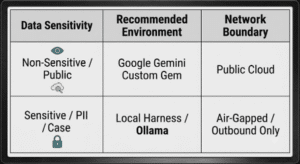
Key Security Safeguards:
- The Cloud Leak Risk: Never feed PII, non-public intelligence, active target identifiers, or confidential client details into public cloud models (e.g., standard ChatGPT, Gemini, Claude web applications) unless covered by enterprise zero-data-retention agreements.
- Active vs. Passive Guardrails: AI agents can be unpredictable. An overeager agent with search or shell access might attempt to scan or probe a target’s web server, compromising your passive posture and alerting the adversary. Enforce hard instructions prohibiting active network probing.
- Data Poisoning & Prompt Injection: When pointed at untrusted web content or third-party repositories, raw text can contain hidden prompt injections designed to hijack the agent’s instructions. Treat all collected content as untrusted data rather than instructions, and require the agent to cite the source line for anything it acts on.
- Local Sovereignty: For sensitive cases, run models locally. The agent harness should access the internet only when explicitly tasked with a passive research query.
Beginner Level: Big-name AI Agents
If you are new to AI agents, this example shows how simple one is to build. For this example, we will use Gemini (Google calls its agents Gems) because most people are familiar with it.
Step-by-Step Setup:
Step 1: Access Gemini: Open Gemini and navigate to the Gem Manager in the drop-down. Create a new Gem.


Step 2: Give it a name or role, and add a description.
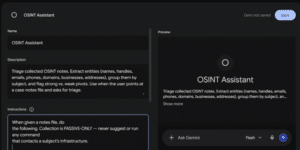
Step 3: System Instructions (The System Prompt): Tell it exactly what you want it to do every time. Here is an example of instructions:
When given a notes file, do the following. Collection is PASSIVE-ONLY — never suggest or run any command that contacts a subject’s infrastructure.
1. READ the file the user names. Work only from its contents.
2. EXTRACT entities into these buckets:
– People / aliases
– Handles & accounts (platform + username)
– Emails
– Phone numbers (normalize to digits; note format variants)
– Domains / websites
– Businesses / orgs
– Physical addresses
3. LINK: note where the same identifier (phone, address, photo, copied ad text) ties two entities together.
4. RATE PIVOTS strong vs. weak:
– STRONG: unique reusable identifiers — email, phone, handle, reused profile photo, verbatim ad text, business registration.
– WEAK: shared hosting/anycast IPs, generic addresses, common names.
5. NEXT STEPS: suggest only PASSIVE follow-ups (public records, registration lookups, archived pages). Never active probing.
6. OUTPUT BLUF: one-line assessment first, then a table of entities, then linkages, then rated pivots, then passive next steps. Cite the source line for each extracted item.
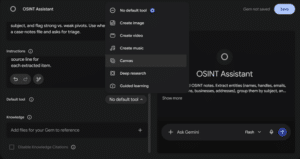
Step 4: Default Tool. If every time you run your workflow you want it to output an image, pick ‘Create Image’; if you want to research, click Deep Research, etc. Canvas is a helpful one if you want to edit the document using AI right away. You can alternatively specify an output file type in the instructions i.e. “always output an attached .md, .ppt, .pdf, and .csv of the data.”
Step 5: Knowledge. Most AI agent builders give you the option to upload some files for the agent to reference each time it executes its task. An example is: if you have a manual for the tradecraft you want to apply, with a glossary of words you want it to use. I would recommend converting the files to simple text or Markdown before uploading, as it is far lighter than having the agent parse and OCR image-heavy documents every time it runs.
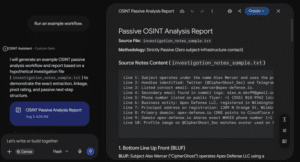
Step 6: Profit. You have now streamlined a process, whatever it may be. With my new agent up and running, I asked it to run an example of its workflow.
Advanced Level: Sovereign AI & Local Workflows
When you are working with case files, PII, or informant notes, a cloud AI is off the table unless your agency holds an enterprise agreement guaranteeing your data is never stored or used for training. Everything below runs on hardware you control instead.
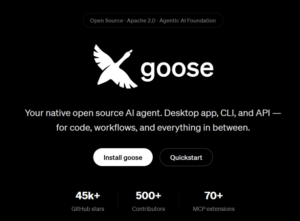
Step 1: Install Goose: Download the desktop app from the project site.
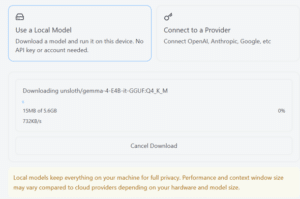
Step 2: Load a local model: Click Use a Local Model and pick your favorite (one Skull Games veteran swears by gemma4:26b-a4b-it-q8_0) or whichever Goose thinks will work best on your system. Whatever model you pick has to support tool calling; that is what lets an agent open files rather than chat. The Gemma 4 builds do it natively; several popular models do not.
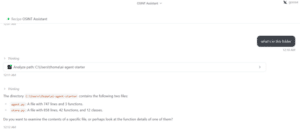
Step 3: Confirm it runs: Start a session and send a simple prompt before you add any tools. Expect the first response to take 30 to 120 seconds while the model loads into memory; after that it settles down. If it answers, your whole stack — agent and model — becomes a single application running on your own hardware.
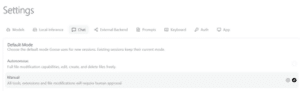
Step 4: Set it to Manual approve mode in settings: The agent now stops and asks permission before every action it takes. That single setting is most of your security posture — nothing happens on your machine that you did not approve.
Step 5: Block the network tools: Mark any tool that reaches the internet as never allow. Passive-only collection is now enforced rather than requested: the agent cannot touch a subject’s infrastructure even if it decides it should.
Step 6: Point it at a case folder: Put your notes, exports, and scrapes in one folder and start Goose there. Give it the same instructions you wrote for your Gem. It reads through the files, pulls out names, handles, emails, phone numbers, domains, and addresses, notes where they connect, and writes the results out — pausing for your approval at each step.
Step 7: Test it offline: Turn off Wi-Fi and run it again. If it still works, you have proof that nothing is leaving your computer.
Step 8: The payoff: hand a folder of raw collection to your own machine and get back a structured entity list with a source citation for every item — the sorting done, the analysis still yours, and no case material in front of a vendor. One honest caveat: local models are less reliable at tool use than the big cloud ones, so expect to supervise more than the demos suggest.
Analyst Checklist: Agentic OSINT Readiness
Before executing your next AI-assisted investigation, run through this final checklist:
- Data Classification Verified: Is the data public/non-sensitive (Cloud Gem fine) or case-sensitive/PII (Local Model required)?
- Passive Guardrails In Place: Does the system instruction ban active network probing — and is there a network-level block behind it?
- Workspace Isolated: Is the restriction actually enforced — by a container, a micro-VM, or MCP tool scoping — rather than only requested in the system prompt?
- Model Selection: Is your local model (any tool-calling Gemma 4 build, quantized to fit your memory) loaded through Goose’s built-in local inference?
- Scope Discipline: Have you broken the workflow into short, reviewable steps — one input, defined output buckets — rather than one long multi-stage run?
- Human Review: Have you verified the generated ExSum, Wiki, and structured reports against source line citations?
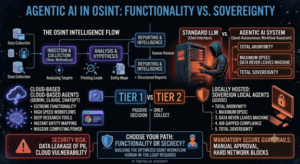
By combining AI agents and structured prompts with local agents and enforced permissions, OSINT analysts can cut hours of processing overhead without surrendering control of their case data — provided the guardrails are enforced in the environment and not just written into the prompt. This allows you to enjoy all the benefits of Agentic AI while balancing functionality and security based on risk.
Upcoming Events
- Task Force Expedition XXI | November 7 – 8 | Austin, TX
Skull Games Links
- Social Media: Follow Us Linkedin Facebook Insta Twitter
- Donations: Support Us
- Law Enforcement: Partner With Us
- Volunteer: Join Us
About the Author

Tom Phelan is an active-duty U.S. Army Intelligence Officer with over five years of experience in OSINT and a dedicated volunteer for Skull Games Task Force.

Olinda Cardenas is a former crime scene investigator turned cybercrime enthusiast. She specializes in OSINT and financial crime investigations and is a dedicated volunteer with Skull Games