

In This Issue
Operations and Training: Operation Support, Texas and Oklahoma
2025 Impact: Expanding the Fight
OSINT Tradecraft: Deepfake Detection (Part 1)
Who We Are
The Skull Games Task Force employs Open Source Intelligence to IDENTIFY sexual predators and their victims, enabling law enforcement to INTERDICT the cycle of abuse. Our mission is to liberate survivors and EMPOWER them with the opportunity for a life of hope, healing, and freedom. The Task Force provides direct support to law enforcement through small teams or as a massive expedition, bringing together the collective capability of more than 400 elite volunteers. This counter-sexual exploitation offensive leverages considerable expertise and resources to fight human trafficking and sexual exploitation. With us as the HUNTERS, we get into the heads of predators, in our own “SKULL GAME”…
December Operations and Training Recap
by Olinda Cardenas
- Predators Arrested: 23
- Victims Recovered and Offered Assistance: 13
- Individuals Trained in Countertrafficking: 21
As 2025 concluded, Skull Games Solutions continued to provide direct operational and intelligence support to local and state law enforcement agencies across multiple jurisdictions, reinforcing the value of coordinated, intelligence-led collaboration.
In December, Skull Games supported an operation with the 27th District Task Force in Oklahoma, resulting in four buyers arrested and two victims recovered. Feedback from law enforcement highlighted the effectiveness of the intelligence provided, particularly the accuracy of suspect identification, which directly contributed to operational confidence and on-the-ground outcomes.
Additionally, Skull Games stood shoulder-to-shoulder with local and state partners in Alabama and Texas as part of the Interstate Justice Coalition. Working alongside trusted NGO partners, teams combined real-time intelligence, digital identification, and on-the-ground coordination to support active investigations and victim recovery efforts.
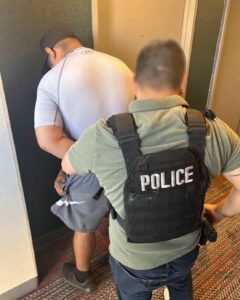

That multi-day effort resulted in the following:
- 14 exploiters arrested, including 3 actively seeking children
- 6 victims of trafficking recovered and connected to services
- 6 additional victims identified for future recovery operations
- 3 traffickers identified, either under arrest or under active investigation
Across each operation, one truth remains consistent: these crimes hide in plain sight. Among those arrested were individuals embedded in their communities, including a high school football coach and others with violent criminal histories. This work exists precisely because exploitation does not look the way people expect it to.
2025 Impact
by Olinda Cardenas
Online sex trafficking in America isn’t happening in the shadows. It’s happening in plain sight- on apps our kids use, in schools, neighborhoods, and everyday digital spaces. At Skull Games Solutions, we see the truth every day: 88% of victims are missed, 71% knew their trafficker, 65% of recruitment happens online, 99.96% of victims are never detected…
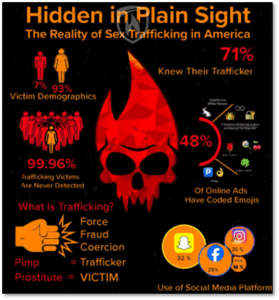
Skull Games interdicts sex trafficking by identifying predators and their prey with the help of law enforcement partners, corporate sponsors, and individual donors. As 2025 came to a close, the impact of our work was both measurable and meaningful when compared to 2024. Predator arrests increased by 199%. Victim recoveries rose by 209%. Online identification of predators and victims grew by 133%, expanding early intervention and investigative reach nationwide. Overall, Skull Games contributed to the fight against human trafficking with 984 predators and victims identified online, 10,877 investigative hours, 295 sex predators arrested, and 158 victims offered assistance.
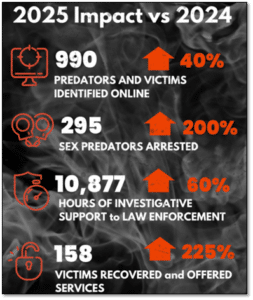
These numbers reflect more than metrics. They represent victims brought to safety, investigations accelerated, and law enforcement empowered with actionable intelligence. Executive Director of Skull Games, Jeff Tiegs, reflected, “Skull Games Solutions exists for the moments most people never see, a girl quietly brought back to her loved ones, a trafficker identified before another victim is harmed, an exhausted investigator realizing they’re no longer alone in the fight.”
Looking ahead to 2026, the mission continues with renewed urgency. Threats evolve, but so do the partnerships, tools, and resolve behind this work. Continued donations and support directly fund operations, training, and victim recovery efforts. The calendar may turn, but the work does not stop. Donate today and be part of the solution.
OSINT Tradecraft: Deepfake Detection (Part 1)
by Tom Phelan
It’s a new year, and our resolution is not to get tricked by AI-generated personas. In the intelligence community, we are increasingly battling deepfakes: media that has been digitally manipulated or completely synthesized by AI to replace someone’s likeness with another or to create a fictional human from thin air. The evolving sophistication of deepfakes has overwhelmingly negative implications. Cyber threats use deepfakes to impersonate celebrities and world leaders to spread disinformation. Criminals use AI-generated personas to negatively influence social media and even groom victims for human trafficking. In what might be a two- or three-part project, we will learn the best tools and tradecraft for countering this problem. I started this research project seeking the solution every OSINT analyst wants for their workflow: a free, browser- or extension-based deepfake image detector that can accurately identify whether an image is natural or AI-generated, with unlimited detections and simultaneous uploads. A fairy tale, most likely, but I asked the Skull Games Task Force what they used and did independent research to find some options to try. Let’s get to work.
The Setup: Iron Mike and “Elara”
To set up our experiment, I had to come up with real and AI-generated images to feed into these detectors to get a good idea of their accuracy. I didn’t want to take it easy on them either; I wanted to stress the tools. I thought a public figure could confuse the sensors, so I chose a celebrity who surely would not sue us for using their public image without their permission for a good cause: the undisputed heavyweight champion of the world, Mike Tyson. I found a common photo of him and had Gemini 3 and ChatGPT 5.2 generate fake images of him.
I also used Gemini to create a person from scratch. Her name ended up being Elara; she likes hiking and photography and is from somewhere in the Pacific Northwest. ChatGPT and Gemini created their versions of her image. I used lenso.ai and Google Lens to make sure none of these supposedly AI-generated images were real. I then used the Elara reverse image searches to find the closest real image to her—a picture from a Marmot ad (again, don’t sue us). To make things even harder for the sensors, I cropped and flipped the images to remove any AI watermarks.
The Experiment Results
I ran these images through the detectors, and the results were… revealing. Bottom Line: Can free browser AI image detectors consistently and accurately detect deepfakes? No. They cannot. BUT— Here are the results so you know which to avoid like the plague and which you can maybe trust.
- AI or Not – Overall Result: FAIL.
Correctly identified the real Mike Tyson as real, and multiple AI-generated images as fake. But it thought the ChatGPT Elara (which I think looks the most AI) was real. And then it thought the real “Elara” was a deepfake. To be sure, I uploaded a personal unedited photo, and it thought that was a deepfake. So, for those fails and the fact that it only gives around 10 free checks a day, I award it no points.

- Illuminarty – Overall Result: FAIL.
It did even worse. It identified the real Mike Tyson as real, but said all the other images were authentic, too. The only image it said was a deepfake was my LinkedIn photo!

- Reversely – Overall Result: FAIL.
It thought that 3 of 4 AI images were real and thought that the real Mike Tyson was a deepfake. It identified the very convincing Gemini Mike Tyson as AI, but overall accuracy/consistency is a fail.

- Hugging Face Space by Aaronespasa – Overall Result: FAIL.
I tried this because Hugging Face is a good resource for open-source AI apps, and I liked that the app highlighted the anomalous area in the image with a heat map. But it was inaccurate too. It correctly identified one of the Mike Tysons as fake, but was wrong about the others.

- Fake Image Detect – Overall Result: FAIL.
This was, in fact, the worst. It identified all AI personas as real and all real photos as deepfakes. Highly discouraging, but I didn’t lose hope.

- Sight Engine – Overall Result: PASS.
Sight Engine actually performed quite well. It identified fake and real photos with very high accuracy and determined which AI model was likely used to generate each image. The only image that deceived it was the Gemini rendering of Mike Tyson, but it offered that it was only 91% confident the image was real. I can give Sight Engine my seal of approval, but note that it only gives a few free checks in a row unless you make an account. The free account gives you a generous 500 checks a day. They also offer APIs and AI music detection.

- FaceOnLive – Overall Result: PASS.
Finally, our hero. FaceOnLive provided accurate detections and many uploads without a subscription or login. Note that the Gemini deepfake of Mike Tyson also fooled FaceOnLive, but it still performed well.

Why AI Faces Are So Hard to Catch
Why is it so hard for these tools to get it right? Modern AI-generated faces are difficult to detect because the models are no longer just “pasting” features. They are calculating lighting, skin texture, and reflections in a way that mimics real physics. This is why you need to use other OSINT tradecraft and analysis to detect fakes. You have to look for:
- Background Anachronisms: AI often fails at making text or specific tools (like hiking gear) look functional.
- Anatomical Anomalies: Even with 2026 tech, ears and the way hair interacts with shoulders can still get messy.
- Cross-Platform Verification: Searching for the persona across multiple platforms to see if their “history” holds up.
No AI Image Detector will ever be 100% effective, and in later articles, we will go over how to achieve a complete solution by using forensic analysis of the image and expanding the investigation beyond the image. But I feel confident recommending FaceOnLive and Sight Engine for your OSINT workflows.
Upcoming Events
- Task Force Expedition XVIII | January 23-25 |Summit Point, WV Remote (Winter Weather Emergencies will not stop us!)
Skull Games Links
- Social Media: Follow Us Linkedin Facebook Insta Twitter
- Donations: Support Us
- Law Enforcement: Partner With Us
- Volunteer: Join Us
About the Author

Tom Phelan is an active-duty U.S. Army Intelligence Officer with over five years of experience in OSINT and a dedicated volunteer for Skull Games Task Force.

Olinda Cardenas is a former crime scene investigator turned cybercrime enthusiast. She specializes in OSINT and financial crime investigations and is a dedicated volunteer with Skull Games